How To Pick Local Keywords
If you think keyword research is just about high-volume terms you find in a tool, you’re missing the "local" in Local SEO. In my world, a keyword with 10 monthly searches can be worth $10,000 if that searcher is three blocks away and ready to buy.
Here is my boots-on-the-ground guide to finding and actually using keywords that drive real foot traffic.
1. The Local Keyword Spectrum: Explicit vs. Implicit Intent
Before you open a single tool, you have to understand how people search in 2026. There are two main ways Google connects users to local businesses:
- Explicit Local Keywords: These are searches where the user tells Google exactly where they are looking.
- Example: "Emergency plumber Grandville MI" or "Pizza near Millennium Park."
- Lucy’s Take: These are your "bread and butter." They are easier to track and rank for because the intent is crystal clear.
- Implicit Local Keywords: These are searches where the location is implied by the user’s GPS or IP address.
- Example: "Plumber" or "best pizza."
- Lucy’s Take: Google knows where the user is. To win these, your business needs to be prominent and relevant to that specific coordinates.
2. Finding the "Golden" Keywords (The Hunt)
I don't just rely on big-name tools like Semrush or Ahrefs (though they are great for competitive intel). I look where the actual conversations are happening.
A. The "Community Listen"
- Google Business Profile (GBP) Insights: Check your "Queries used to find you" report. This is pure gold. It shows the exact phrases locals used to find your listing last month.
- Google Search Console (GSC): Look for "near me" variations you’re already ranking for but perhaps not in the top three.
- Mining Customer Reviews: I read through client reviews (and their competitors'). If customers keep saying "best gluten-free crust in the West Side," then "gluten-free crust West Side" is a keyword you need to own.
B. The Tool Kit
- Google Keyword Planner: Still the king for getting raw data straight from the source.
- Google Trends: Essential for seeing if a service is seasonal (e.g., "snow removal" vs. "lawn aeration").
- AnswerThePublic: Great for finding the questions locals are asking (e.g., "how much does a plumber cost in Grandville?").
3. Going "Hyper-Local": Beyond the City Modifier
Everyone targets "City + Service." If you want to beat the big guys, you have to go deeper. We call this Hyper-Local SEO.
- Neighborhoods
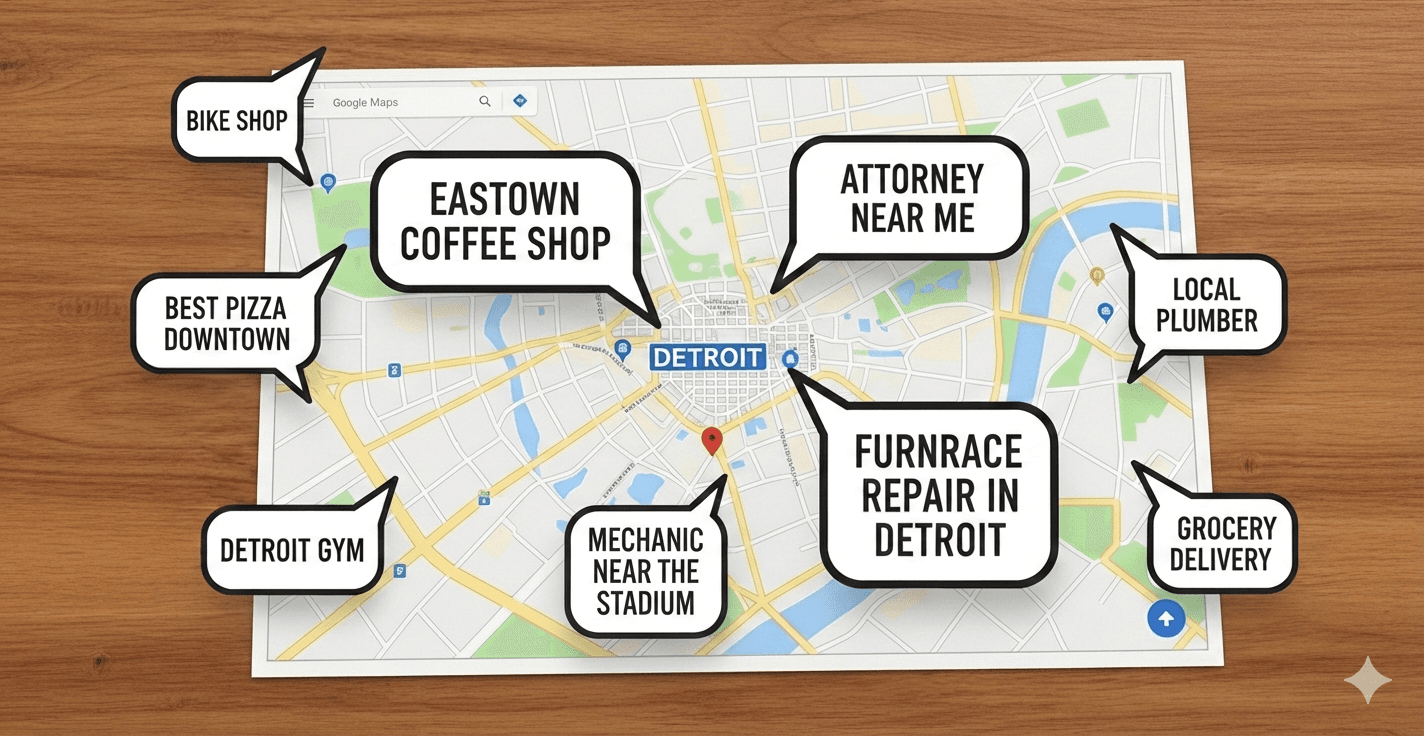
- Example: "Eastown Coffee Shop"
- Why it Works: Targets people within a specific, highly localized radius (like a 5-block area).
- Landmarks
- Example: "Attorney near Kent County Courthouse"
- Why it Works: Captures high-intent searches from users who are already physically at a specific destination.
- Intersections
- Example: "Mechanic near 28th and Wilson"
- Why it Works: Extremely effective for mobile users who are navigating or searching while driving.
- Zip Codes
- Example: "49418 Handyman"
- Why it Works: Signals extreme proximity and confirms the business operates within the user's specific service area.
4. How to Utilize Your Keywords (Deployment)
Finding them is only half the battle. You have to put them where Google’s AI and human users will see them.
On-Page Optimization
Don't just "stuff" keywords. Tell a story about your location.
- Title Tags & H1s: Use your primary service + primary city. (e.g., "24/7 Emergency Plumber in Detroit, MI | ABC Plumbing")
- Local Landing Pages: If you serve multiple areas, create a page for each. But don't just swap the city name—mention local landmarks, parking situations, or even local events you’ve sponsored.
- The "Directions" Copy: Write out driving directions from a major landmark. "We’re just two minutes south of the Grandville Library..." This signals "locality" to Google's crawlers.
Off-Page & Google Business Profile
- GBP Services & Products: Don't just list "Plumbing." Use the keywords you found: "Water Heater Repair," "Drain Cleaning," "Sump Pump Installation."
- Image Alt Text: When you upload photos of your work, name them kitchen-remodeling-grandville-mi.jpg and use descriptive alt text.
- Review Responses: When replying to reviews, weave in keywords naturally. "Glad we could help with your emergency pipe repair here in Grandville!"
5. The 2026 Edge: Optimizing for AI Overviews
In 2026, Google often summarizes local results using AI. To show up here, your keywords need to be backed by authoritative context.
Google looks for "E-E-A-T" (Experience, Expertise, Authoritativeness, and Trustworthiness). Don't just say you're a plumber; show a photo of your van in front of a local landmark. Use LocalBusiness Schema Markup to tell the AI exactly what your coordinates, hours, and service area are in a language it speaks (JSON-LD).
Ready to dominate your local map?
Finding the right keywords is the foundation of every successful campaign I run. If you can speak the language your neighbors are using, you’re already halfway to a conversion.